From Outside Magazine. You should be able to access it for free. Some excerpts below.
They were climbing Broad Peak, the 12th highest mountain in the world.
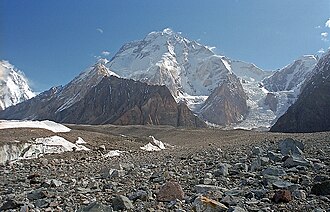
Among the climbers on Broad Peak was legendary mountain guide and former 800er speed record-holder Nirmal “Nims” Purja, 43, who was chasing one of the most ambitious objectives of his career: becoming the first person to climb all 14 peaks that rise above 8,000 meters (26,000 feet) without supplemental oxygen—twice. After he summited Broad Peak, only 26,864-foot Cho Oyu in China would stand between him and the accolade.
**************************
At around 9 A.M., Jenjen Lama of Seven Summit Treks was climbing towards Camp II on K2 with a group of clients. He looked across the glacial valley and saw a massive avalanche thunder down Broad Peak. Although avalanches on that section of the route are common, this slide was bigger and more destructive than ones Lama had seen before.
Lama switched on his radio and tried to contact Gyalu and Nawang Thindu. There was no response.
“I thought they probably just had their radios switched off to save battery,” Lama said. “So I called down to Base Camp and told them to keep checking in with the team.”
**************************
Climbing expeditions in Pakistan’s Karakoram Range are much different than the ultra-connected luxury expeditions common on Mount Everest and other peaks in Nepal. The remoteness of the Karakoram region and lack of private helicopter service limit the staff size of each expedition, and also the communications and transportation. Most importantly, the area lacks reliable cell service or internet. Any telecommunications relies on expensive satellite technology, as the Starlink sets popular on Everest won’t work on Broad Peak and its surrounding mountains. While many climbers transmit their position live from GPS trackers, Base Camp teams can’t access the data without reliable internet. Instead, they rely solely on radio communication to keep in touch with their teams on the mountain.
It didn’t take long for the expedition leaders on K2 to abandon their climbs. They were now unsettled by the avalanche conditions ahead of them, and knew full well that additional manpower would be needed for a major rescue effort on Broad Peak.
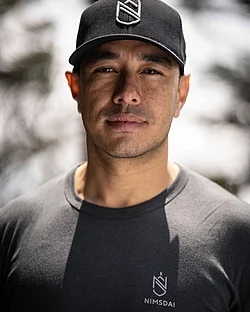
Nirmal Purja
The following morning, July 31, Lama descended to K2 Base Camp, where he established a command center focused primarily on rescuing his SST colleagues Gelu and Nawang Thindu and their client, Al Harthy.
That same morning, two Pakistan Army helicopters flew over Broad Peak in search of survivors, while a joint team of Pakistani and Nepali rescuers combed through the avalanche debris. The team recovered the bodies of Al Harthy and Gurung, along with a detached leg that was later identified as belonging to Geis.
****************************
“We were completely covered, but we survived,” Speed Dawa told Outside. “We were still at least 450 feet from Nawang Thindu, and we started thinking about our families and our children. ‘We’re out of rope. The dead are gone,’ we thought. ‘We don’t have any option but to turn around.’”
*****************************
A trekker, John Visnic from Colorado, whose Instagram handle is @chocolatemilkman27, at Broad Peak Base Camp watched the second avalanche from a distance. “We were the only people camped at Broad Peak Base Camp the evening of August 2,” he wrote to Outside via Instagram message. “We witnessed two sherpa on the valley floor at the base of the avalanche probing. One with a shovel and [the] other with what appeared to be a pole. At this moment, a small avalanche from the same glacier occurred at 4:30 P.M., and the wet slide brought a body in an orange suit to the valley floor. The two sherpa retrieved the body.”
Only then did Speed Dawa fully appreciate how narrowly the rescue team had escaped death.
*****************************
With the 2026 Karakoram climbing season drawing to a close and resources now limited, the bodies of Sakhi and Nawang Thindu, as well as any final remains of Mallory Geis, will likely remain on Broad Peak for the foreseeable future.